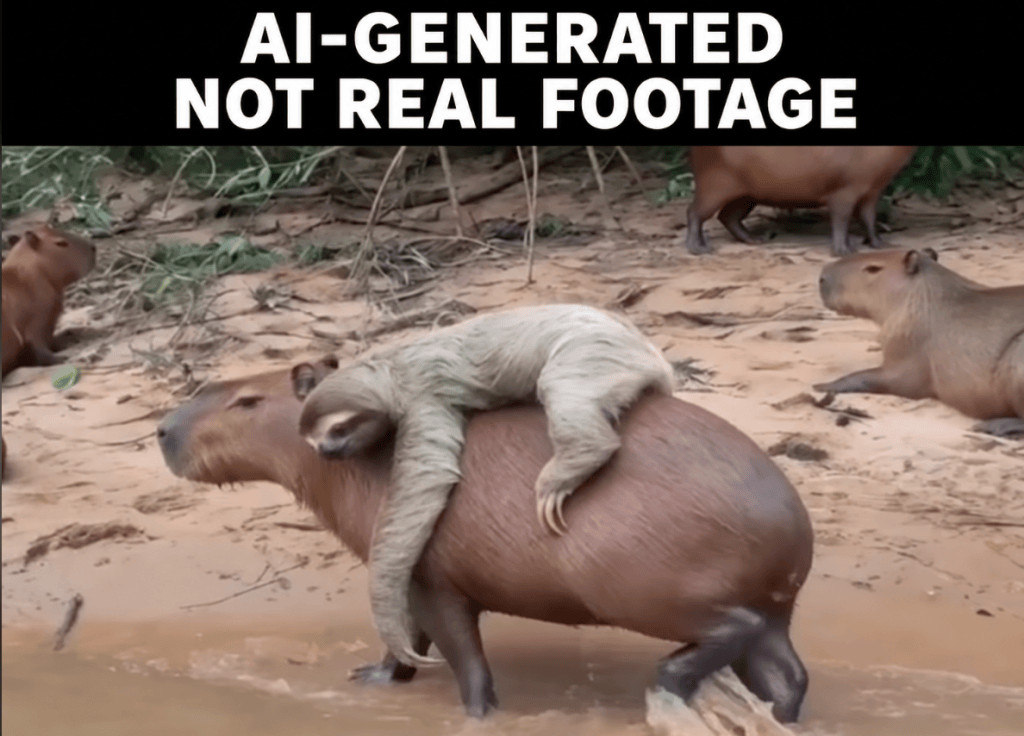
I once reposted an Instagram video of a sloth falling from a tree into water and a capybara carrying it on its back. I thought it was a sweet animal video. Apparently, it was also something I should have questioned.
When I showed it to my cousin, who was in seventh grade, she immediately told me it was AI. I was shocked and honestly embarrassed. I spend plenty of time online, but I had accepted the scene without checking where it came from.
Her comment made me realize how easily an emotional reaction can come before a question about whether something is real. In that moment, I wanted to share a cute video. But what happens when the same reaction leads someone to buy a product, believe a false statement, or trust a person who never actually said what they appear to be saying?
That is where my concerns about AI-generated content begin. I use AI and find it helpful. I also think the people publishing it have a responsibility to consider what their audience could reasonably believe.
Helpful Does Not Always Mean Trustworthy
I have used AI to explore book recommendations, understand confusing information, and organize study notes. When I was unsure about something involving my car, asking follow-up questions helped me understand the explanation better.
Those experiences make me see the value in AI assistance. In content strategy, there are practical uses too. Alex Lindley’s Semrush guide describes using AI for content briefs, keyword ideas, topic organization, and maintaining a brand voice. It also points out that chatbot suggestions do not necessarily reflect actual Google search data and that generated briefs need review.
A useful example would be a content creator asking AI to organize existing blog topics into categories, then checking whether those categories match the audience’s needs. AI could also produce an initial transcript or suggest a clearer heading.
Those tasks help someone work through material. Creating a fictional customer who claims to have used a product introduces a very different problem.
The Perfume Recommendation Huda Never Gave
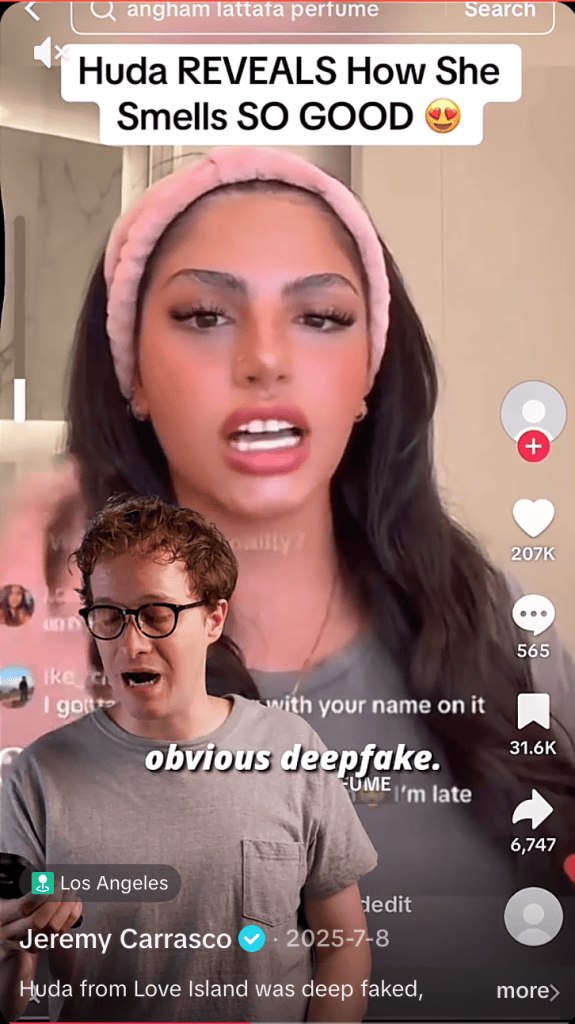
I remember seeing videos that appeared to show Huda Mustafa from Love Island USA recommending a perfume. They used her appearance and voice to make the recommendation feel personal and believable.
This was not just something I misremembered. In a July 2025 interview with Allure, Mustafa confirmed that she had not created the AI perfume content circulating online and did not wear the featured fragrance.
That bothers me because an endorsement carries someone’s reputation with it. A viewer might recognize Huda, remember the conversations about her scent, and assume the recommendation is genuine.
There is also an important distinction between someone posting a fake promotional video and the product’s manufacturer commissioning it. Without evidence, I would not assume the company behind the perfume made those videos. Whoever publishes an endorsement still needs to consider whether it falsely represents another person’s experience.
What the Law Actually Addresses
In the United States, the Federal Trade Commission’s Consumer Reviews and Testimonials Rule addresses fake or false reviews and endorsements, including AI-generated examples. Businesses can face liability for prohibited conduct, and knowing violations can carry civil penalties.
The FTC specifically explains that using a celebrity avatar without permission can violate the rule when reasonable consumers would believe the celebrity genuinely endorsed the product. However, it does not impose a blanket ban on AI avatars in marketing. The context and the truthfulness of the underlying message matter.
That distinction is useful. A clearly fictional character introducing a product is different from pretending a real person tried it and loved it. Adding an AI label should not be treated as permission to fabricate evidence or someone’s approval.
Copyright raises a separate question. The U.S. Copyright Office explains that purely AI-generated expression does not receive copyright protection, while sufficiently creative human contributions can. Simply providing prompts does not establish authorship of the generated output. Using AI as an assistant does not automatically prevent a larger human-authored work from qualifying for protection.
This means “I used AI” does not settle ownership. It also does not establish permission to use someone else’s photograph, writing, or other protected material. Creators need to consider both their inputs and what they publish.
Rules also differ by jurisdiction. In the European Union, Article 50 of the AI Act requires disclosure for covered deepfakes and certain AI-generated public-interest text, with specific exceptions. Its provisions distinguish those publishing obligations from providers’ technical marking requirements. There is no single worldwide labeling rule covering every AI use in the same way.
A Label Helps, but It Does Not Make Me Want the Product
Personally, I appreciate knowing when something is AI-generated. I would rather a company disclose it than hope I do not notice.
Still, disclosure would not necessarily persuade me to buy something. If I am looking at clothing or skincare, I want useful evidence of how it fits, looks, or performs. A generated demonstration would leave me wanting to see the product on an actual person.
My reaction is not proof that everyone feels the same way. However, broader research shows considerable concern. In a June 2026 Pew Research Center survey, 52% of U.S. adults said they were more concerned than excited about AI’s growing role in daily life, compared with 9% who were more excited. That measures general attitudes toward AI, rather than preferences about a particular advertisement.
I especially worry about people who have had less exposure to generated images or cloned voices. My own experience reminded me that being familiar with social media does not mean I will always recognize synthetic content.
I also care about consent. A playful image made by someone close to me would feel different from a company using my face or voice commercially without asking. Payment would not be the only issue. I would want to know what I was agreeing to and how I would be represented.
What Responsible Use Looks Like to Me
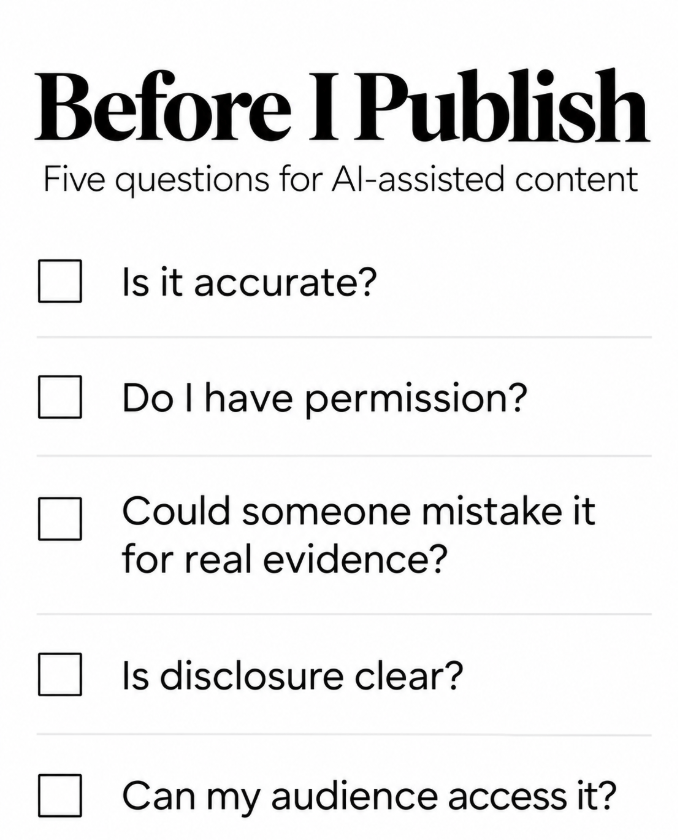
I think the amount of oversight should reflect what could happen if the content is wrong.
AI might automatically group internal files or suggest tags, with occasional checks. Public product claims, endorsements, and sensitive information deserve review before publication. Even a fully generated fictional illustration can be appropriate when the creator has checked relevant rights and made its purpose clear. Human editing alone does not make misleading content acceptable.
For a beauty brand, a responsible approach could involve using AI to organize common customer questions, then having a knowledgeable person verify the answers. An unacceptable approach would be inventing a customer’s before-and-after results and presenting them as evidence.
Accessibility belongs in that process too. W3C explains that meaningful images need equivalent alternative text and that audio information can be made accessible through transcripts. AI can help draft these materials, but people need to check that they accurately communicate the content. W3C also emphasizes that automated tools alone cannot establish whether a website is accessible.
The Audience Should Not Have to Guess
Looking back at the sloth video, I wish I had questioned it before sharing it. I also understand why I did not. It caught my attention, made me feel something, and seemed harmless enough to repost.
Someone creating public content has the opportunity to make that decision easier for the next person. They can explain what is generated, verify their claims, respect people’s permission, and correct mistakes.
I will keep using AI when it helps me learn or work through an idea. But when I am deciding what to publish, or what to buy, I want to know whose experience I am actually being asked to trust.
Sources
- Federal Trade Commission. The Consumer Reviews and Testimonials Rule: Questions and Answers.
- Johnson, K. (2025, July 21). Everyone Wants to Know What Huda Mustafa Smells Like. Allure.
- Lindley, A. (2025, December 5). How to Use AI for a Content Strategy That Drives Results. Semrush.
- McClain, C., & Park, E. (2026, August 18). Young Adults in the U.S. Are Increasingly Wary of AI, Concerned It Will Take Jobs. Pew Research Center.
- U.S. Copyright Office. (2025, January 29). Copyright Office Releases Part 2 of Artificial Intelligence Report.
- European Commission. Article 50: Transparency Obligations for Providers and Deployers of Certain AI Systems.
- W3C Web Accessibility Initiative. Introduction to Web Accessibility.


Leave a Reply