September 22, 2025
I’ve spent considerable time feeling like a failure, not in my job or academics, but in my capacity to simply concentrate. I would create all of these to-do list, yet my mind felt like a chaotic whirlwind. I attempted everything from, buying millions of planners and an array of stickers to the “ten-minute rule” to postpone checking notifications, meditation apps to soothe my racing thoughts, and rigid time-boxing schedules to keep me on course. I even experimented with screen-time app blockers that felt like digital restraints. Still, despite my best intentions, I found myself endlessly scrolling through feeds, diving into rabbit holes, and feeling constantly distracted.
I believed the issue had to have started with me. My willpower might be weak. My self-discipline might be insufficient. I was buying into the belief that the answer to a world filled with digital distractions was to simply be “indistractable,” to outlast the algorithms with pure determination. It’s a tempting thought, isn’t it? The self-help industry flourishes on it, promising a glimmer of hope that feels almost cruel in its simplicity. Then I came across Johann Hari’s “Stolen Focus”, and everything shifted.
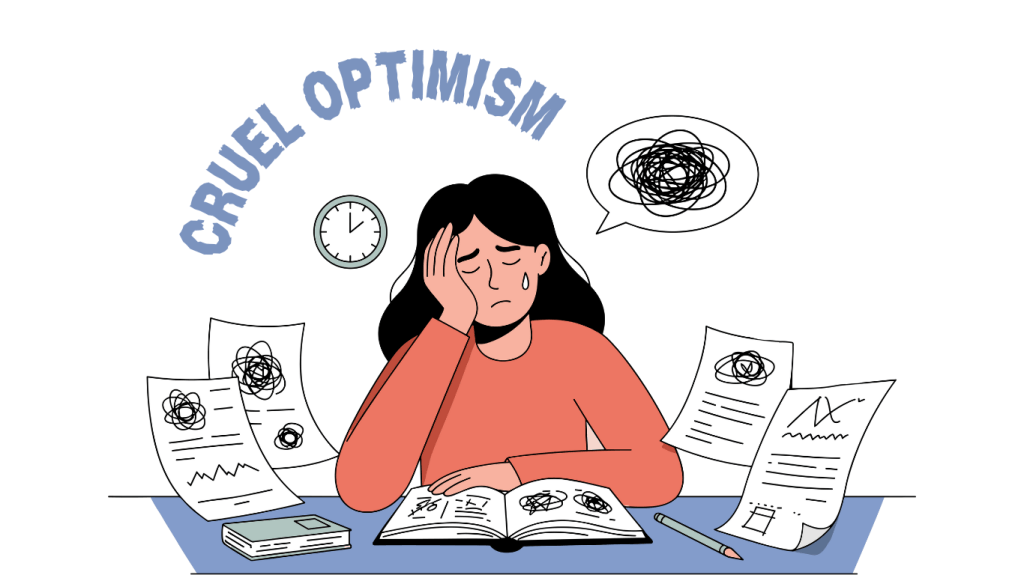
Hari presents the idea of “cruel optimism,” a term created by cultural theorist Lauren Berlant. It suggests that we are being sold solutions that are fundamentally not enough for the magnitude of the problem. My personal time-boxing was not simply an insignificant tool, but it was a “band-aid” for a “severed limb.” It was like I was apart of a fight, but I was the one being told to bring a knife in a gun fight and I would get through it. This new perspective brought relief and was a necessary wake-up call. It’s not that these personal strategies are useless, but they serve as “authentic optimism” only when integrated into a broader approach. While we can improve our individual habits, we cannot overlook the environment in which we are fighting. The battle for our focus is not 100% created by ourselves, it’s a systemic war executed by powerful external forces.
This understanding led me to the book’s deeper, more troubling revelation, which is the fundamental issue is surveillance capitalism. The platforms we use daily aren’t free and our attention and data serve as the currency. The true clients are not us, but the advertisers and corporations looking to sell us products. This business model clarifies why every app is carefully crafted to be as addictive as possible. Behavioral scientists are hired to create hooks and triggers that draw us back, and as Hari points out, the algorithms have “learned” that anger and outrage serve as the most effective hooks. Our natural negativity bias is leveraged for profit, resulting in a society that is not only less focused but also more divided and discontented.
So, how do we move forward? If the problem is systemic, then the solution must be collective. Hari compellingly argues that we need to advocate for a digital environment that prioritizes human objectives, not just corporate metrics. He references historical examples like we’ve collectively created regulations to prohibit harmful products like lead paint or to guarantee food safety, we can pursue the same standards from our digital tools. This could involve moving away from surveillance capitalism towards business models that do not depend on monopolizing our attention. This isn’t a quest for personal willpower; it’s a struggle for a healthier, more focused society.
This viewpoint has entirely shifted my understanding of my own challenges and my role as a researcher. I’m no longer simply attempting to manage my time, but I’m working to comprehend and navigate an inherently flawed system. My individual attempts to concentrate have evolved into a form of resistance. The irritation I experience when I get sucked into an endless stream, even when I know I am wasting my time as I am scrolling, it serves as a signal, not of a personal weakness, but of a structural issue. This collective frustration, as Hari highlights, lays a strong groundwork for transformation. It represents a shared, unspoken recognition that there must be a more effective way to engage with technology. The ultimate goal is to repair the system itself, creating an environment where deep thinking is not an extraordinary skill but a straightforward, attainable action.
This no longer only pertains to me or my task list, but it concerns all of us.


Leave a Reply