September 13, 2025
I made the decision to take a “detox” from social media, mainly to limit my TikTok usage. I realized I was spending excessive time aimlessly browsing through videos, instead of doing things that benefit my mental health and overall well-being. I wanted to explore how a break would affect my overall digital habits. The outcomes were more unexpected and enlightening than I anticipated. This was not just a pause from social media, it was an experiment to gain insight into my connection with my phone. There wasn’t just one motive for pursuing this digital detox, the reasons were to alleviate anxiety, enhance sleep quality, and regain time for more constructive and beneficial actives. For example, I want to go on more walks, learn how to sew, or even start scrapbooking. Not only do I want to take on this challenge to maybe start a new hobby, but I just want to block out any noise that will distract me from doing work and hold me back from being the best version of myself. I hoped to see a notable decline in my screen time and an improvement in my general well-being.
Prior to the Detox: My Online Behaviors
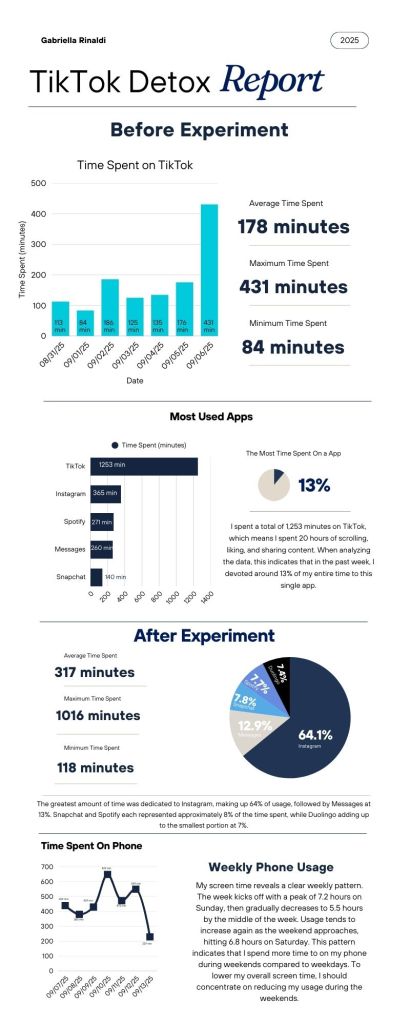
Reflecting on my usage prior to the experiment, it became clear where most of my time was spent. In just a week, I accumulated a total of 1,253 minutes on TikTok, translating to over 20 hours spent on consuming, liking, and sharing posts. The analysis revealed that I was spending approximately 13% of my time that week on this one app. My average daily screen time was already quite high at 178 minutes (almost 3 hours), peaking at 431 minutes on September 6th.
The distribution of my app usage highlighted a similar trend of significant social media engagement. Instagram was my second most utilized app with 365 minutes, followed by Spotify at 271 minutes, Messages at 260 minutes, and Snapchat at 140 minutes. Such excessive screen time is frequently related to the rising feelings of anxiety, small attention spans, and an ongoing fear of missing out (FOMO). I was certainly feeling the pressure and was ready to make a shift.
The After: The Surprising Turn
The detox was successful in one aspect, which was, I successfully lowered my dependence on TikTok. However, the data from the week that followed the experiment showed an unexpected and important development. My average daily screen time didn’t go down, it actually increased. It spiked to an average of 317 minutes each day. What caused this? I simply substituted one habit for another. Instead of spending hours on TikTok, I found myself dedicating even more time to Instagram, which represented 64.1% of my total app usage. Messaging was the second most used category at 12.9%, with apps like Snapchat, Spotify, and Duolingo trailing behind. This is a typical trend for many individuals attempting to detox from social media. Our attention span is limited, and when we eliminate one source of distraction, our minds often look to fill that gap with another source. The true problem isn’t the app itself, but the fundamental psychological need for ongoing stimulation and connection.
The Larger Perspective: My Weekly Usage of Screens
Upon examining my screen time from September 7th to September 13th, a distinct weekly trend became apparent. My screen usage peaked during the weekends, reaching 7.2 hours on Sunday and experiencing another increase on Saturday. Usage then decreased throughout the week, with the lowest point occurring on Wednesday. This trend aligns with research suggesting that screen time tends to increase on weekends due to more leisure opportunities and fewer scheduled activities. For many people, the weekend serves as a time for passive entertainment, making our phones the most accessible option.
The most important takeaway from the detox was that it is insufficient to simply remove one app. The true challenge lies in addressing the fundamental behaviors and establishing healthy limits concerning technology, particularly on the days I am most prone to losing track of time. This experiment was less about “curing” my phone dependency and more about gaining insight into my habits. It demonstrated that genuine digital well-being is not solely about avoiding a specific platform; rather, it involves being more intentional with my device usage. It is about reclaiming control from the constant notifications and seeking a better middle ground between my digital and real-life experiences.
 The Dark Edit
Leave a comment