The Dark Edit

Stories, culture, design, and life online through my lens.

  • September 22, 2025

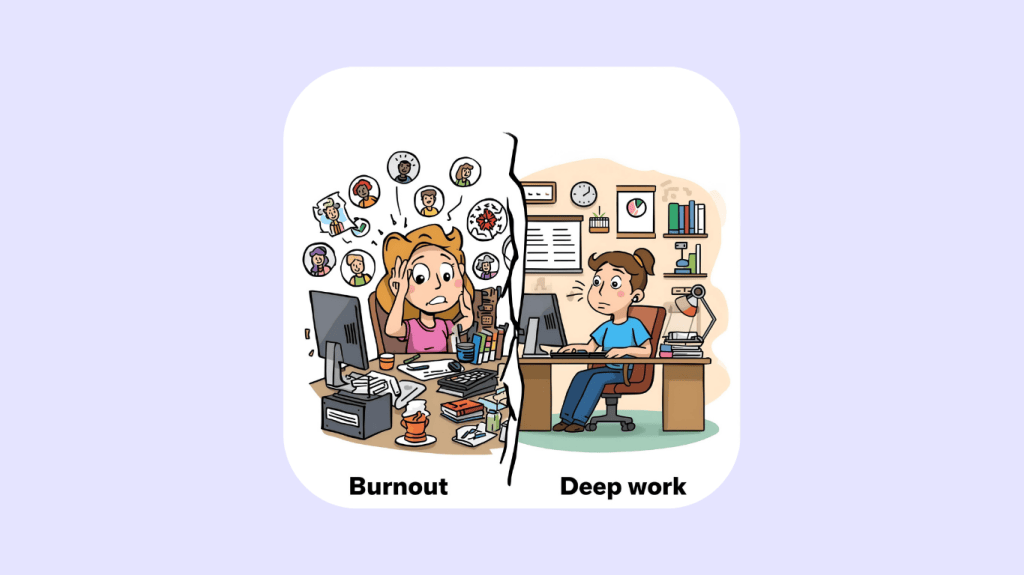
    I’ve spent considerable time feeling like a failure, not in my job or academics, but in my capacity to simply concentrate. I would create all of these to-do list, yet my mind felt like a chaotic whirlwind. I attempted everything from, buying millions of planners and an array of stickers to the “ten-minute rule” to postpone checking notifications, meditation apps to soothe my racing thoughts, and rigid time-boxing schedules to keep me on course. I even experimented with screen-time app blockers that felt like digital restraints. Still, despite my best intentions, I found myself endlessly scrolling through feeds, diving into rabbit holes, and feeling constantly distracted.

    I believed the issue had to have started with me. My willpower might be weak. My self-discipline might be insufficient. I was buying into the belief that the answer to a world filled with digital distractions was to simply be “indistractable,” to outlast the algorithms with pure determination. It’s a tempting thought, isn’t it? The self-help industry flourishes on it, promising a glimmer of hope that feels almost cruel in its simplicity. Then I came across Johann Hari’s “Stolen Focus”, and everything shifted.

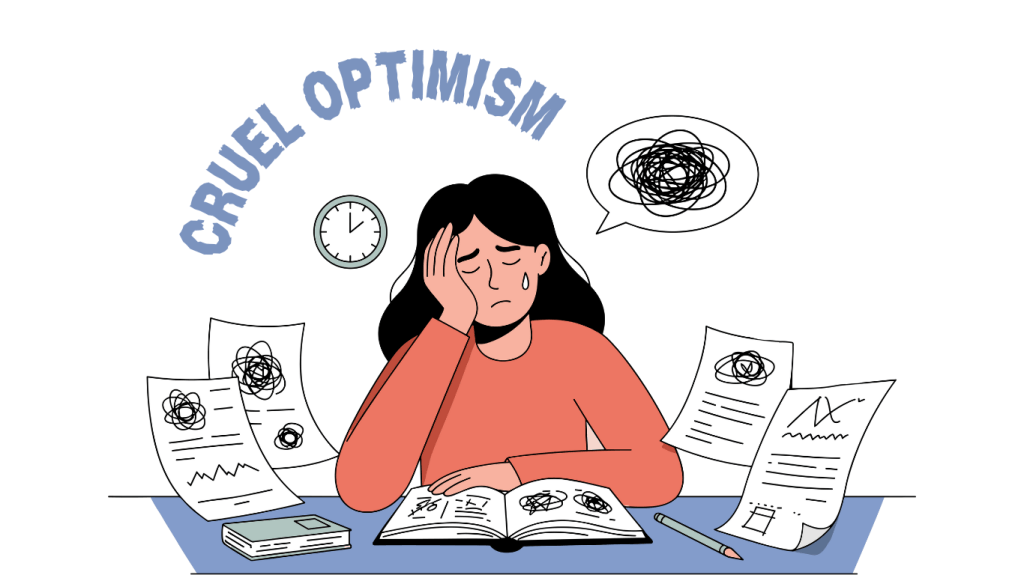
    Hari presents the idea of “cruel optimism,” a term created by cultural theorist Lauren Berlant. It suggests that we are being sold solutions that are fundamentally not enough for the magnitude of the problem. My personal time-boxing was not simply an insignificant tool, but it was a “band-aid” for a “severed limb.” It was like I was apart of a fight, but I was the one being told to bring a knife in a gun fight and I would get through it. This new perspective brought relief and was a necessary wake-up call. It’s not that these personal strategies are useless, but they serve as “authentic optimism” only when integrated into a broader approach. While we can improve our individual habits, we cannot overlook the environment in which we are fighting. The battle for our focus is not 100% created by ourselves, it’s a systemic war executed by powerful external forces.

    This understanding led me to the book’s deeper, more troubling revelation, which is the fundamental issue is surveillance capitalism. The platforms we use daily aren’t free and our attention and data serve as the currency. The true clients are not us, but the advertisers and corporations looking to sell us products. This business model clarifies why every app is carefully crafted to be as addictive as possible. Behavioral scientists are hired to create hooks and triggers that draw us back, and as Hari points out, the algorithms have “learned” that anger and outrage serve as the most effective hooks. Our natural negativity bias is leveraged for profit, resulting in a society that is not only less focused but also more divided and discontented.

    So, how do we move forward? If the problem is systemic, then the solution must be collective. Hari compellingly argues that we need to advocate for a digital environment that prioritizes human objectives, not just corporate metrics. He references historical examples like we’ve collectively created regulations to prohibit harmful products like lead paint or to guarantee food safety, we can pursue the same standards from our digital tools. This could involve moving away from surveillance capitalism towards business models that do not depend on monopolizing our attention. This isn’t a quest for personal willpower; it’s a struggle for a healthier, more focused society.

    This viewpoint has entirely shifted my understanding of my own challenges and my role as a researcher. I’m no longer simply attempting to manage my time, but I’m working to comprehend and navigate an inherently flawed system. My individual attempts to concentrate have evolved into a form of resistance. The irritation I experience when I get sucked into an endless stream, even when I know I am wasting my time as I am scrolling, it serves as a signal, not of a personal weakness, but of a structural issue. This collective frustration, as Hari highlights, lays a strong groundwork for transformation. It represents a shared, unspoken recognition that there must be a more effective way to engage with technology. The ultimate goal is to repair the system itself, creating an environment where deep thinking is not an extraordinary skill but a straightforward, attainable action.

    This no longer only pertains to me or my task list, but it concerns all of us.

  • September 8, 2025

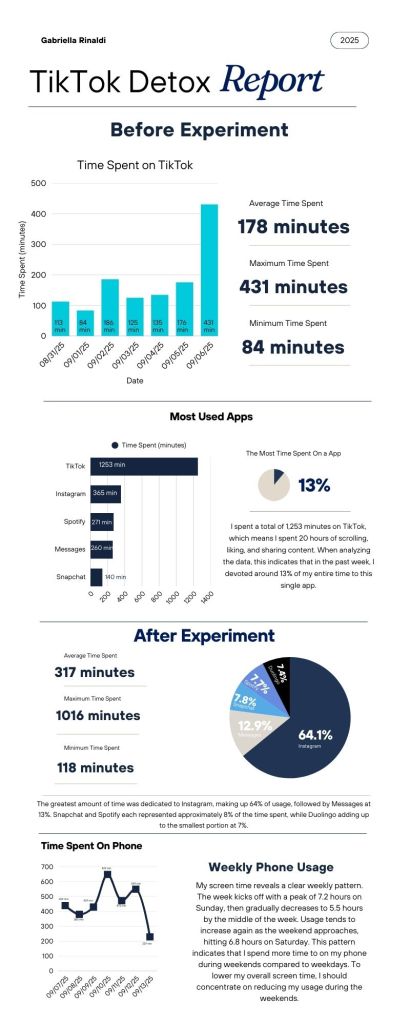
    As a graduate student, I often find myself in a relentless struggle for time. There never seem to be enough hours for schoolwork, spending time with family, getting exercise, and most importantly, taking care of my mental health. Recently, I decided to perform a straightforward analysis of how I spend my time by writing out where all 168 hours of my week actually go. The result was somewhat surprising. Although I spent 20 hours doing schoolwork and 8 to my job, I unfortunately spent 30 hours consumed by social media.

    This wasn’t 100%  a surprise, but it was most definitely a wake-up call. One of my primary focuses is my mental well-being, and I had to face the fact that the time that was being used wasn’t beneficial to it. In my reflective writing, I realized that I spend most of my time in aimless scrolling, which leads to negativity absorbing my mind. This revelation led me to explore a broader cultural issue discussed in my recent readings, which is the gradual decline of our ability to concentrate.

    My struggle to disconnect from scrolling and my difficulty in fully engaging with a book isn’t personal defect. It reflects the impact of our current media landscape. In his essay “I have forgotten how to read,” Michael Harris describes his loss of the capacity for deep focus, explaining that his mind “bucks” when presented with a simple paperback. Like many, he has been rewired. The internet conditions us to adopt a “cynical” reading approach, where we hunt for useful information or shareable links rather than taking time for ourselves throughout the day in a book.

    Johann Hari expands on this in Stolen Focus, arguing that the shift from physical books to screens is fundamentally altering our thought processes. While reading a book trains the mind to follow a linear narrative, the web, which has its links and notifications, “reprograms your brain to read in a fragmented and disjointed manner.” This constant skimming diminishes our “cognitive patience,” which is the capacity to engage with complex ideas. It’s hardly surprising that after spending 30 hours in a skimming mode, my ambition to read more seems like an uphill struggle. This broken mindset also undermines our ability to empathize, as Hari points out. Deeply engaging in stories serves as a workout for our capacity to understand others, an experience that skimming through social media cannot authentically provide.

    So why do we resort to this behavior? We frequently turn to our devices to escape feelings of boredom. However, intriguing studies on “digital switching” indicate that this tactic may backfire. Research has shown that participants given the freedom to switch between multiple videos reported feeling more bored and less fulfilled than those who viewed a single video in its entirety. The lead author explained that rapid switching sets back deep engagement, making the content feel “insignificant.”

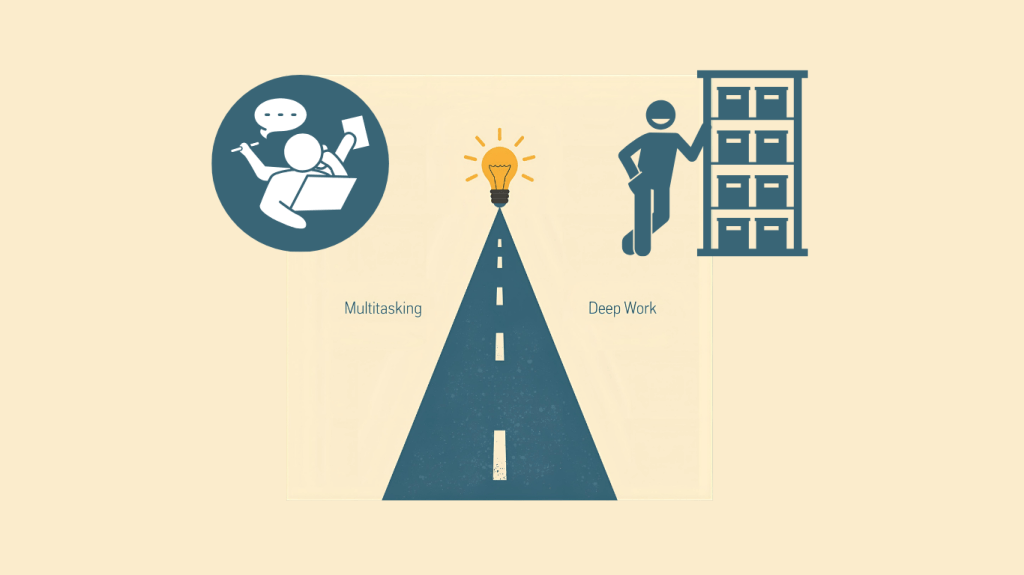
    This presents a central contradiction, which is that we occupy every free moment to fend off boredom, yet in doing so, we strip away something vital. In another section of Stolen Focus, Hari emphasizes the benefits of allowing our minds to roam. During moments when we aren’t concentrating on a specific task, such as when we’re on a bus or waiting in line, our brain’s “default mode network” (DMN) becomes active. This is when real cognitive work occurs, which means our brain links concepts, solidifies memories, and solves problems creatively. That enlightening moment rarely occurs from forcing our attention on a screen. But when it happens, it emerges when we take a step back and let our thoughts wander. By removing lazy moments, we unintentionally undermine our own creativity, which is one of my most significant personal principles.

    Identifying the issue is one thing, but taking action on it is another. My time spent looking into everything highlighted that my behaviors do not match my objectives. I believe that the way forward involves becoming what experts refer to as an “Active Reader.” Unlike passive readers who quickly forget information after reading, active readers interact with the text by jotting down notes, posing questions, and minimizing distractions. It’s about reading deliberately and with intention.

    In the end, the aim is to achieve that state of “flow,” a term introduced by psychologist Mihály Csíkszentmihályi to describe a condition of total fixation and energized concentration. Flow occurs in the ideal space where a task pushes your abilities without being overwhelming. It stands in sharp contrast to the anxious, scattered sensation of a lengthy session of mindless scrolling. It embodies the profound, fulfilling engagement that I believe we all desire.

    My personal plan of action is straightforward yet effective. I will start by reducing my screen time before going to bed and dedicating more time to reading. It’s not about never using technology but rather about taking back my time and, in turn, my focus. It will require discipline to step away, but if I want to succeed as a student and in my future career, I must first take charge of how I spend my time.

  • Creating Significant Fashion Communities in the Attention Economy

    September 1st, 2025

    For as long as I can remember, I’ve been interested by the detail of storytelling. My journey, from earning a communication degree at SUNY Cortland to currently pursuing a Master’s in Interactive Media, has been driven by a desire to comprehend how fashion brands can cultivate authentic communities. My ambition is to become a Social Media Manager who gets to craft those compelling digital narratives that resonate with people and since I enjoy the fashion world, to combine both of my passions together and become a Social Media Manager for a fashion brand.

    Recently, however, I’ve been wrestling with a significant question at the core of my chosen profession. The very platforms where we narrate these stories are structured to disrupt our attention. So, how can we create a genuine community when we are all existing in an attention economy that thrives on our distractions? This question has weighed heavily on my mind, particularly after engaging with research such as Johann Hari’s Stolen Focus and reflecting on that familiar feeling of being eternally “stuck in a scroll.”

    Reading the introduction and chapters one through three of Stolen Focus was genuinely eye-opening for me. In an interview discussing the book, Johann Hari compellingly argues that the shame we experience regarding our lack of focus is misguided. It’s not a flaw in our character. He outlines how our digital environment is designed to capture our attention, with elements like the infinite scroll and algorithmic feeds aimed at keeping our attention for extended periods. It’s a business model that exchanges profound thought for superficial, relentless engagement.

    I was curious to observe this phenomenon firsthand, I undertook a straightforward experiment that proved to be unexpectedly challenging. The New York Times’ “Test Your Focus” exercise, which the objective was simply to gaze at a painting for ten minutes. Seemed simple, right? It was far from it. Within the initial minutes, my brain felt like it was throwing a tantrum. I experienced a genuine, physical urge to glance at my phone, switch tabs, or do literally anything else.

    Yet I pushed through, and a shift occurred. I pushed past the mental chaos, and the artwork, which was Whistler’s “Nocturne in Blue and Silver” truly began to spring to life. I picked up the details I had completely overlooked earlier. For example, the soft glow of the lights, the serene atmosphere, the single figure on the shore. My focus transformed from a quick glance to a profound, fixed stare. In that moment, I recognized the difference between merely consuming content and genuinely attending. It served as the ideal real-world illustration of the crisis Hari discusses.

    This brings me back to the primary question I’m confronting as I get closer to my future career. If everyone is trained to scroll past everything, how can you create stories that genuinely matter?

    I’m beginning to suspect the solution doesn’t lie in producing even louder, faster content to prevail in the battle for attention. The path ahead, particularly in a creative field like fashion, must revolve around developing a different type of environment. It’s about crafting materials that earn and respect our audience’s focus. It’s about progressing beyond pursuing viral metrics to forge genuine connections, something marketing specialists are beginning to refer to as “slow content.”

    What might that entail in practical terms? Perhaps it involves a beautifully composed article, a mini-documentary about a collection, or an interactive lookbook that invites exploration. It’s about utilizing a platform like Instagram to narrate a coherent story over time, rather than merely presenting a disorganized assembly of images. It’s about creating dialogues and nurture a community where individuals feel like they are part of something, rather than just a target for advertisements.

    The skills that I will be learning in my Master’s program will extend beyond just becoming experienced with the tools, but they’re also going to be about comprehending the individuals on the other side of the screen. My ambition is to avoid becoming yet another contributor to the overwhelming digital noise. I aspire to be a storyteller who produces content that deserves to be noticed. It’s a significant challenge, but my brief ten-minute experiment with a painting reminded me of a fundamental truth that genuine value lies not in the continuous scrolling, but in the instances that compel us to pause. That’s the type of work I aim to create.

  • Welcome to WordPress! This is your first post. Edit or delete it to take the first step in your blogging journey.